

Marx Tuchmann
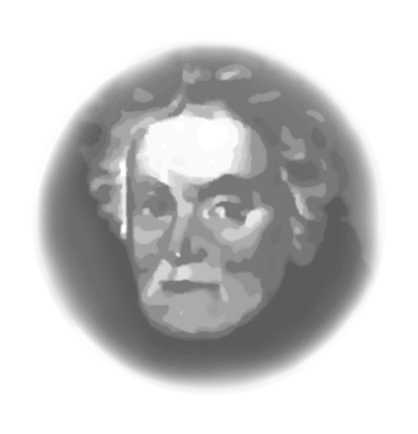
edited from the chronicles of Mr. Moritz Tuchmann (T VIII)
(written 1895).
Moritz Tuchmann writes: "I start with my maternal grandmother, called Babette or Aunt Heindel ‐ who died at the old age of 96 and was said to have been vigorous in her 90th year (died May 6, 1838). I do not remember either her or her husband Josef Marum Engelmann (died in 1823). This grandmother of mine is said to have been a capable, energetic trader ‐ as my mother often told me ‐ that generally, at that time, the women in Floss were almost as much, if not more, involved in trading than their husbands, and I remember that these women went for weeks in their tarpaulin‐covered wagons on trips to the trade in Bohemia. ‐
I will come back to my blessed mother later, as I would like to mention above all my father, the ancestral patriarch of the Tuchmann family. Before the introduction of the German names for Jews (1813) he called himself Mordochai Josef Levi and after the change mentioned that he signed himself to Marx Tuchmann".
Franz Tuchmann (T IV C) tells the following: When my grandfather was asked by the district judge in Neustadt ⁄ Aisch which German name he wanted to take, he was very careful to get the name as short as possible and, in view of this, suggested that he was trading in hops, proposed the name Hopf, which was refused to him because shortly beforehand another (Simon Hopf) had already accepted this name. Since my grandfather also traded in Höpfen ‐cloth, he got the idea to use the name "cloth man" (Tuchmann). "According to his statement, he was born in Baiersdorf, but did not know his parents and was brought to Ühlfeld as a little boy, where a woman (related or not) took care of him and raised him".
Attached here is a letter from Ühlfeld's teacher Wormser, dated March 15, 1891: Widow Babette Rindsberg told me most definitely; Her late brother‐in‐law, the Glaser Mosche Rindsberg, often told her, because he was the brother ‐in‐law of the butcher Isak Kohn, his wife Schenla was his sister to him: this Schenla and Isak Kohn's father was Cheskel and Cheskel's father was the widowered Mother of blessed Marx Tuchmann, who was also a widow in Baiersdorf, married and really this Marx Tuchmann was carried here in a carrying basket (Kenze). ‐ So Marx Tuchmann was blessed as the stepbrother to old Cheskel Kohn. Marx Tuchmann is said to have traded in hops cloth, haberdashery and old iron, pewter, etc. before the hops trade. The first name of Cheskel's father, i.e. Marx Tuchmann's stepfather, is not known. . . ‐ Little Marx's foster mother was his real mother, who brought him from Baiersdorf to Ühlfeld herself and who remarried there.
Moritz Tuchmann continues: "I can hardly tell you anything about my father's youth, I know that.. but that he progressed
through diligence and thrift and later supported his mother and many poor relatives with his savings. In my opinion he was the
founder of the Tuchmann hop business. His first occupation was peddling cutlery and a few years ago I was in possession of the
carrying basket that he carried on his back. Through contact with Jewish traders in Floß Farming he also got to know Miriam
Engelmann; after that he often visited those areas and this way he usually came through Hersbruck and Hohenstadt, where he
made the acquaintance of Bohemian hop traders who came to buy there at the time. He immediately seized this branch and for many
years delivered large batches of hops to Hersbruck, which enabled him to do so; to give up the peddling business and to devote
himself to the hops trade. As a result, he made a considerable fortune for the time, built a large house with barns to store hops
and kept buying farmland. Meadows and woodlands and in the summer ran economy with large livestock. In the meantime the income
from this rural occupation was almost negligible, but my father had once absorbed the idea that all protests on the part of my
mother were in vain. It was a hustle and bustle with servants, male and female servants and even all of us brothers and sisters
had to go out in the field with work. At that time the sulfurizing of