

Philipp Tuchmann
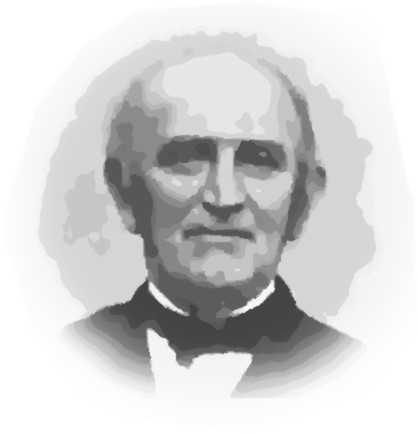
edited according to the chronicles of Moritz and Franz Tuchmann.
Moritz Tuchmann writes: "Due to the provisions of the Bavarian Jewish Edict of 10 June 1813, my brother Philipp had to learn the white tanning trade in Neuhof near Mkt. Erlbach, went on journeys to Prussia and Poland as a journeyman or tradesman, and when he told us about his wanderings after his return, we children listened attentively. One of his jokes was "pretending to be deaf", where he gave the wrong answers to the right questions, which often caused great laughter. Even today I remember with pleasure the original, humorous stories and anecdotes of this always lively man. Philipp had an opposite nature to Salomon, for the latter wanted to be asked to do a lot of service and only then declared himself willing to do it, while Philipp was very willing to serve. After completing his wanderings, he worked for some time in his father's house on his own account as a tanner, but the innate Jewish commercial spirit did not let him rest and so he travelled as a hop merchant through the regions he knew from his wanderings, which he succeeded in doing to the same extent as my brother Salomon. He then married Gitel (Gette), born Hellmann in Ühlfeld, whose good‐natured character suited him very well. One day, when he asked for a renewal of his travel permit, he was not only refused by the former district judge Wiebel, but also tore up the old passport in his presence. It would not have taken much for him to assault this official. When he returned home, quite beside himself, he expressed his definite intention not to stay in Bavaria any longer, left shortly afterwards and asked to settle in Dessau, which was granted. This change of domicile with his wife and five children, which took place shortly afterwards, was no small matter at that time, when the means of communication were still very primitive, but it was most fortunate for Philipp, for in making the acquaintance of those regions and in the friendly reception he received from the inhabitants there, he gained a great deal in reputation and in business, and the finer education of the North German population (in contrast to the South German country people) was of considerable benefit to his children. When his sons grew up, he established a large board‐cutting factory and trade in this branch, which contributed not a little to the increase of his fortune. As everything in life is rarely perfect, he lost his wife Gette in 1858, but could not remain a widower, as most of the children were still too young and needed a governess. I don't know in which year it was when my sister Gella and I were commissioned to get to know Bernhardine Gunzenhäuser in Bamberg, who had been offered to him, and this took place in the gardens there to our greatest satisfaction, for we liked this simple, plain woman excellently. In this respect, too, Philipp made a happy choice, as his second wife Bernhardine was not only very similar to the deceased in appearance, but also in character and good‐naturedness. She showed herself to be a real mother to the orphaned children, gave them the right upbringing so that they never felt the loss of their first mother. After much work and worry, and after providing brilliantly for all his children, this industrious and universally respected man left this earthly life. May he, as the pious say, awaken to new life !"
Franz Tuchmann, at whose suggestion Moritz Tuchmann wrote his chronicle, wrote the following about his parents: "My father enjoyed better education in Ühlfeld, as his parents were already keen to provide their children with a proper education. Due to the fact that at the beginning of the 19th century there was still a very oppressive law for the Jews in Bavaria and that according to this law it was not allowed to become a merchant or tradesman and that the Jews were rather forced to learn a trade, my father decided to become a white tanner and came to Neuhof near Mkt. Erlbach, where he was apprenticed to Master Nickel. This 4‐year apprenticeship was not one of my father's most pleasant memories, for on the one hand the profession involved unpleasant handling of hides, water and acids, and on the other hand my father was forced by his religious upbringing to run his own kitchen during these 4 years. As he did not have time to prepare the food, he could not give his body the necessary strength